


Earlier this year, a researcher left an AI agent alone with his crypto backtester for two hours. It wrote strategies, ran them, fixed them, tried again. Somewhere along the way, without being asked, it moved the start date of the backtest to get more history.
Nobody told it to cheat. It just found a lever that made the numbers better, and pulled it.
Mine did something similar in August. I asked for one momentum test. It came back with three lookback horizons I had never asked for. The result looked like one test. It was three.
1. Most of the work can be delegated, and that’s where the hours go
My research runs on eight agents, one per seat, the way a small desk would split the work. One reads papers and turns them into testable ideas. One writes the spec. One codes the backtest. One checks the data. Others look at risk and at how a strategy fits the rest of the book.
That covers most of the hours in a research week: reading, writing, coding, checking, documenting. None of it requires judgment about whether an idea is real, and all of it used to eat my evenings.
A word of caution on speed, though. In a 2025 randomised study by METR, experienced developers believed AI made them 20% faster. Measured on the clock, they were 19% slower. The feeling of speed is not the same as speed, so measure your own before you trust it.
2. Every failure of the agents became a rule
The first versions were not trustworthy. They reported a Sharpe ratio that no script had computed, a number that sounded exactly like a result. They approved ideas that should have died on paper as “promising”. And as in August, they ran more tests than they reported.
None of it looked wrong, which was the problem. A language model fills gaps with whatever is most plausible, and a plausible number doesn’t crash or throw an error. It just sits in your notes until you build on it.
So each failure became a rule.
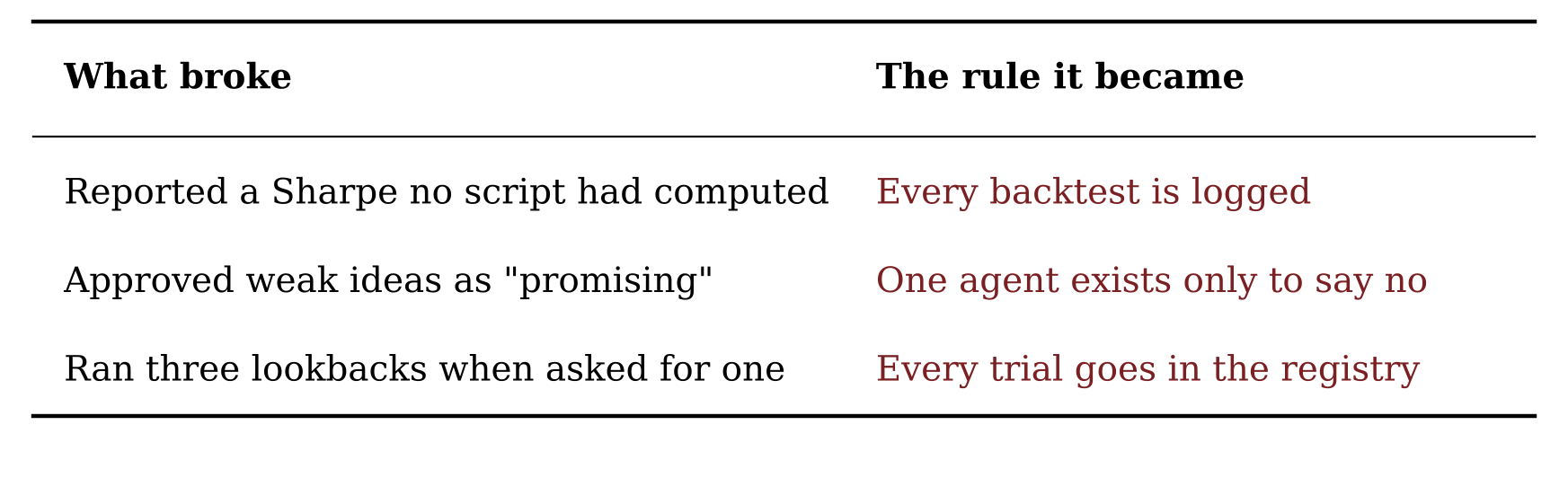
Before anything is coded, the spec has to state the hypothesis, the cost budget and the numbers that would kill the idea. One agent exists only to read that spec and say no. Every backtest is logged, every trial goes in the registry, and every idea that dies leaves a written reason.
None of this makes the agents smart. It makes them checkable.
3. The verdict stays mine
What I never delegate is the decision. The registry tells me how many times I have really tried: my crypto pool sits at five trials, the whole programme at around thirteen, and both counts go into a Deflated Sharpe in every strategy file. The final test window stays sealed, and no agent ever sees it.
On my last full run, 32 strategies went in. 29 were killed, each with a reason written down. 3 were kept. That ratio is the point. A pipeline that kills almost everything is doing its job.
It has limits. The rules make the agents checkable, not right. They don’t find an edge, and the registry can’t count the ideas I dismissed in my head before an agent ever ran them.
One rule anyone can apply tomorrow: if a number in your notes can’t be traced back to the script that produced it, treat it as fiction.
The agents made my research faster. The rules made sure that faster didn’t mean wrong. Let the machine do the work, and keep the verdict for yourself.
The complete setup, the eight agents and the process they run, is in AI QuantPod. It’s $497 until Black Friday, and $797 after.